
How Apple Ads are Changing App Store Search
January 23rd, 2026
 Tagged: A/b Testing, App Listing, App Visibility, App Store Search, App Screenshots, Ai, Apple Ads
By David Bell
CEO at Gummicube, Inc.
Apple has announced a significant update to Apple Ads, formerly known as Apple Search Ads, that will reshape how users encounter apps during App Store searches. Beginning in March 2026, Apple Ads will expand beyond their traditional single placement at the top of search results and appear in additional positions throughout the search experience. This rollout will happen in phases, with full global availability expected by the end of March 2026. For developers and marketers, this update introduces more opportunities to capture user attention at critical moments of discovery, while also increasing competition within search results. Because nearly 65 percent of App Store downloads occur directly after a search, this evolution has meaningful implications for visibility, conversion, and overall App Store Optimization (ASO) strategies.
In this blog, we break down what this update means in practice, how Apple is approaching ad relevance and placement, and why this change further connects Apple Ads performance with strong App Store optimization fundamentals. We will examine how expanded ad inventory impacts search behavior, what developers can expect from the new placement logic, and how teams should think about aligning paid and organic strategies moving forward. By the end, it should be clear that this update is not simply an expansion of ads, but a signal of how Apple continues to refine search as the primary discovery engine within the App Store.
THE EXPANSION OF APPLE ADS WITHIN SEARCH RESULTS
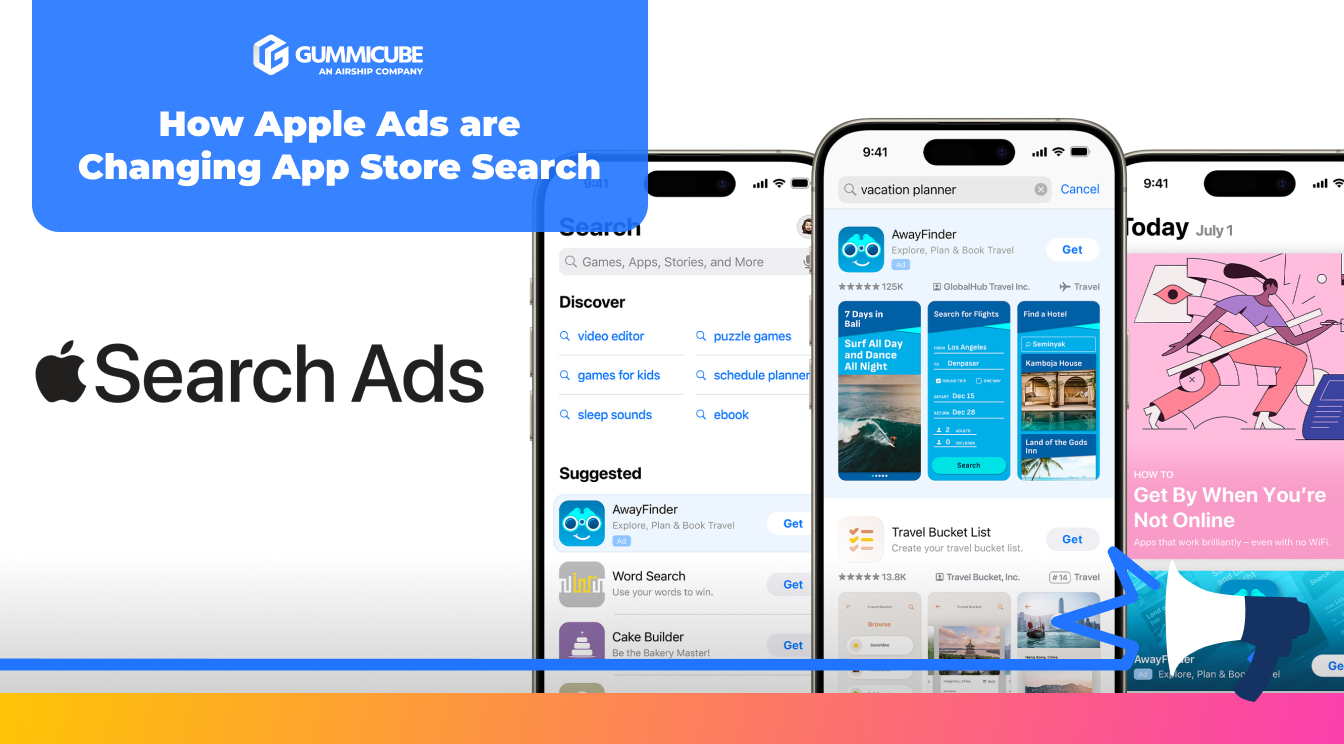
The most immediate change introduced by Apple is the expansion of where ads can appear within App Store search results. Historically, Apple Ads were limited to a single premium position at the very top of the results page. With the March 2026 update, ads may now also appear further down within the same search results. This effectively increases the number of potential touchpoints a user may encounter when searching for an app, while preserving a consistent visual format across all placements.
From a strategic perspective, this expansion acknowledges how users actually engage with search results. While top placement remains valuable, many users scroll, compare options, and evaluate multiple listings before making a download decision. By introducing ads deeper in the results, Apple is creating additional opportunities for relevant apps to stay visible throughout that evaluation process. Importantly, these ads will look the same regardless of placement, ensuring a consistent experience that is neither disruptive nor confusing for users.
Apple has also clarified that developers cannot choose or bid on specific placements. If a campaign is already running, it will automatically be eligible for all available ad positions. Placement is determined by Apple’s internal systems, which evaluate relevance and bid competitiveness at the time of the search. Billing remains unchanged, with advertisers continuing to pay based on their selected pricing model, either cost per tap or cost per install.
This structure reinforces Apple’s emphasis on user experience. By removing manual placement controls, Apple reduces the risk of irrelevant ads appearing in sensitive or inappropriate contexts. Instead, ads are surfaced only when they meet Apple’s relevance standards for a given query. For developers, this means success will rely less on gaming placement and more on ensuring campaigns are tightly aligned with genuine user intent. As search inventory grows, relevance becomes the defining factor that separates high-performing campaigns from wasted spend.
WHY DOES SEARCH RELEVANCE MATTER?
Search has long been the primary discovery mechanism in the App Store, and this update further elevates its importance. With nearly 65 percent of downloads happening directly after a search, Apple is reinforcing search as the most intent-driven environment in the ecosystem. Users who search are not browsing casually. They are actively looking for solutions, entertainment, or tools that meet a specific need. Apple Ads are designed to integrate seamlessly into this high-intent moment.
Apple has been explicit that ads will only appear when an app is relevant to the user's search. Relevance and bid work together, but relevance is the gatekeeper. If an app does not align with the query, it will not enter the auction. This means higher bids cannot compensate for poor keyword alignment or weak metadata. As Apple expands ad placements, it is simultaneously tightening the standards for what qualifies as a match.
Developers can still choose their own keywords or leverage Apple’s suggested keywords, but keyword selection alone is not enough. Apple Ads evaluates relevance holistically, taking into account the app’s title, subtitle, keyword field, category alignment, and overall positioning within the App Store. This is where App Store optimization plays a critical role. Strong ASO ensures that an app clearly communicates what it does and who it is for, which directly supports both organic rankings and paid eligibility.
As ads appear in more positions, competition for visibility increases. However, this competition is not purely financial. It is semantic and contextual. Apps that are clearly positioned and tightly aligned with user intent will benefit most from the expanded inventory. Those with vague messaging or misaligned metadata may find that additional ad opportunities do not translate into meaningful exposure. In this sense, the update rewards discipline and clarity over aggressive bidding alone.
HOW WILL APPLE ADS PLACEMENT WORK UNDER THE NEW MODEL?
One of the most common questions surrounding this update is how Apple determines where ads appear within search results. While Apple does not provide granular details about its auction mechanics, the company has outlined the core principles guiding placement decisions. Ads can appear either in the traditional top position or further down the search results, and placement is dynamically determined for each search.
All ad formats remain consistent across placements, ensuring that no single position has a creative advantage. This consistency allows Apple to evaluate performance based on relevance and engagement rather than visual prominence. Billing remains tied to the advertiser’s chosen model, whether cost per tap or cost per install, and does not change based on placement location.
Crucially, advertisers cannot isolate or optimize toward a specific placement. This removes a layer of manual control but also simplifies campaign management. Rather than fragmenting strategy across multiple placements, advertisers must focus on improving overall relevance and performance. Apple’s system then determines the best placement opportunities for each auction.
This approach reflects Apple’s broader philosophy around automation and user-centric design. By centralizing placement decisions, Apple reduces complexity while maintaining quality. For developers, this means campaign success depends on fundamentals rather than tactical manipulation. Clear value propositions, accurate keyword targeting, and strong conversion-oriented product pages all feed into better outcomes across placements.
From an ASO perspective, this model further blurs the line between paid and organic performance. The same signals that help an app rank organically also help it qualify for and perform well in Apple Ads auctions. As placements expand, the feedback loop between ASO and paid acquisition becomes even tighter, reinforcing the need for an integrated approach.
WHAT THIS MEANS FOR ASO AND PAID APP MARKETING STRATEGIES
This update should be viewed as a strategic inflection point rather than a simple product change. By expanding Apple Ads within search results, Apple is signaling that search will continue to be the central battlefield for app discovery. For developers, this raises the stakes for getting search right, both organically and through paid channels.
App Store optimization is no longer a standalone discipline. It is a foundational layer that supports paid performance, discoverability, and conversion. Strong ASO improves relevance, thereby increasing ad eligibility. It also improves conversion rates, which makes paid campaigns more efficient and scalable. As Apple Ads inventory grows, these efficiencies become even more important.
Developers should expect increased competition for high-value queries, particularly in popular categories. However, the relevance-driven model also creates opportunities for well-positioned niche apps to compete effectively. By clearly articulating their value and aligning metadata with user intent, smaller teams can still win meaningful visibility without excessive spend.
This update also encourages more thoughtful keyword strategies. Rather than chasing broad, expensive terms, developers may find greater success focusing on precise, high-intent queries that reflect real user needs. Apple’s suggested keywords can provide useful insights, but they should be evaluated through the lens of ASO performance and conversion data.
Ultimately, the expansion of Apple Ads reinforces a simple truth. The App Store rewards clarity, relevance, and alignment. Teams that treat ASO and paid acquisition as interconnected parts of the same strategy will be best positioned to adapt as search continues to evolve.
FINAL THOUGHTS
Apple Ads are changing App Store search by expanding ad placements while simultaneously reinforcing relevance as the core driver of visibility. With additional ad opportunities rolling out globally by the end of March 2026, developers will have more chances to reach users during high-intent searches. However, these opportunities come with increased competition and a greater reliance on strong App Store optimization fundamentals. The update makes it clear that paid success cannot exist in isolation. It must be supported by clear positioning, accurate metadata, and a deep understanding of user intent.
LET’S CHAT!
If you are evaluating how this update impacts your current strategy, now is the time to take a closer look at your ASO foundation. Our ASO services are designed to help apps align with user intent, improve relevance, and support sustainable growth across both organic and paid discovery. Let’s chat about how thoughtful App Store optimization can help you navigate the evolving Apple Ads landscape with confidence.
More blog-posts like this:

iOS App Store Updates for Brazilian App Developers
Developers will soon have new options for distributing iOS apps and processing payments in Brazil.

Apple is Rolling Out a Refined Interface for the App Store
At WWDC 2026, Apple unveiled several creative enhancements that give App Store Optimization (ASO) professionals significantly more control over how its apps appear throughout the App Store.

Subscription-based App Developers are Losing Business
A canceled app subscriber is lost revenue that may never return. Read more!