
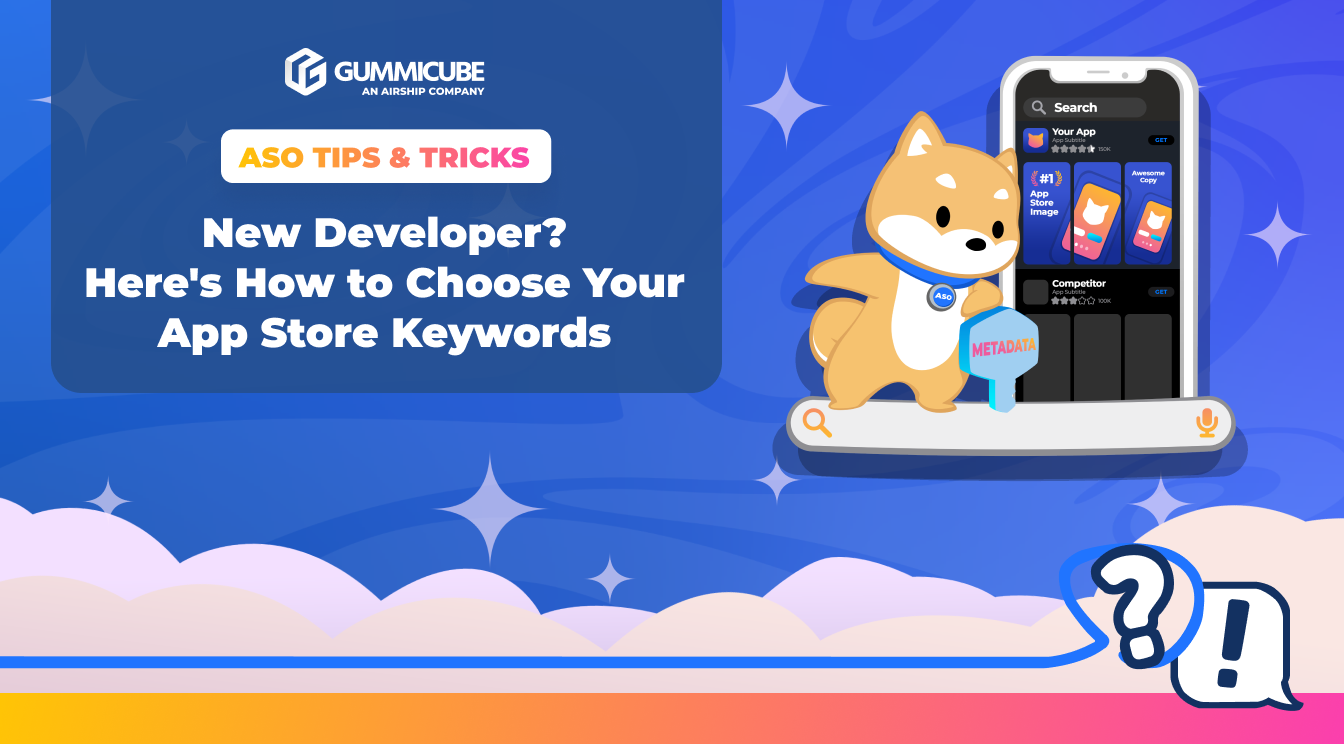
New Developer? Here's How to Choose Your App Store Keywords
August 21st, 2026
 Tagged: Keyword Research Tool
By Anh Nguyen
COO & Co-Founder at Gummicube, Inc
Launching an app is an exciting milestone, but getting your app in front of the right users requires more than simply publishing it to the App Store. With millions of apps competing for attention, developers need a clear strategy for making their listings discoverable, relevant, and compelling. One of the most important components of that strategy is keyword research.
For new developers, choosing keywords for App Store visibility can feel overwhelming. There are countless search terms users could enter, and it can be tempting to target every high-volume keyword possible. However, effective App Store Optimization (ASO) requires a more thoughtful approach. The strongest keyword strategy balances search volume, relevance, competition, and user intent to create a listing that can attract qualified users while clearly communicating what an app offers.
Your app listing should not be treated as a static piece of content that you create once and forget. User behavior changes, competitors update their listings, search trends evolve, and new opportunities emerge within every app category. By understanding where keywords belong, how to research them, and how to continually refine your strategy, you can build a stronger foundation for long-term App Store Optimization.
START WITH THE CORE AREAS OF YOUR APP LISTING
Before researching individual keywords, developers should understand where to incorporate keywords throughout their App Store presence. Apple provides several metadata fields that can contribute to an app’s discoverability, including the app title, subtitle, and dedicated keyword field. The description also plays an important role in communicating the app’s value and helping users determine whether it meets their needs.
The app title is one of the most prominent elements of an App Store listing and should clearly communicate the app’s purpose. Because of its visibility and importance to App Store search, developers should consider including a primary, highly relevant keyword in the title when it can be incorporated naturally. The title should still prioritize clarity and branding, since users need to immediately understand what the app does.
The subtitle provides another opportunity to communicate the app’s value while incorporating additional relevant terminology. Developers can use this space to highlight a core feature, audience, or benefit that complements the title. Rather than repeating the same keyword unnecessarily, the subtitle can expand on the app’s positioning and target related search intent.
Apple also provides a dedicated keyword field that gives developers additional space to target relevant search terms. This field is particularly important for keyword research because it allows developers to identify search opportunities that may not fit naturally into the visible portions of their listing. Developers should use this space strategically instead of filling it with every keyword they can find.
The description serves a slightly different purpose. While developers should naturally incorporate relevant terminology where appropriate, the description should primarily focus on explaining the app, its features, benefits, and value proposition. A well-written description helps users understand why they should download the app once they discover it. Keyword placement should never come at the expense of readability or persuasive messaging.
Together, these elements should create a cohesive listing. Your title, subtitle, keyword field, and description should reinforce the same core message rather than functioning as disconnected places to insert app keywords.
PRIORITIZE KEYWORD RELEVANCE TO APP STORE SEARCH INTENT
One of the most common mistakes new developers make is assuming that the highest volume keyword is automatically the best keyword. Search volume matters, but it should never be the only factor guiding your strategy.
A keyword can have substantial search volume and still be a poor choice for your app if it does not accurately describe what your product offers. For example, targeting a broad, high-volume term simply because many users search for it may bring your app into searches that have little connection to its actual functionality. If users download your app expecting something it does not deliver, those downloads are unlikely to lead to strong long-term engagement.
Relevance should therefore serve as the foundation of your keyword strategy. Ask yourself whether someone searching for a particular term would reasonably expect to find your app. If the answer is no, the keyword probably does not belong in your strategy, regardless of its search volume.
Relevant keywords also help you connect search intent with your app’s value proposition. When a user searches for something specific and encounters an app that clearly addresses that need, the path from search to download becomes more logical. Your listing should make that connection as clear as possible.
This is why effective keyword research is about more than finding popular words. It is about understanding what users are looking for and identifying the terminology that accurately represents your app’s solution.
USE ASO TOOLS TO DISCOVER APP KEYWORD OPPORTUNITIES
Developers do not have to rely on guesswork when researching app keywords. ASO tools can provide valuable data that helps turn keyword research into a more informed and strategic process.
ASO tools such as DATACUBE can help developers analyze real user search data and uncover opportunities within their category. Instead of simply brainstorming words that seem relevant, developers can use data to evaluate factors such as keyword volume, competition, ranking potential, and competitor performance.
This type of research can reveal high-volume keywords that may be worth targeting, but it can also uncover more specific long-tail variations. Long-tail keywords may have lower search volume than broader terms, but they can sometimes offer stronger ranking opportunities because they are more specific and may face less competition.
For example, a developer creating a budgeting app may initially consider a broad term such as “budget.” While that keyword may be relevant, it also represents a very broad search intent. Research could uncover more specific variations related to budget tracking, expense tracking, family budgeting, or personal finance management. The strongest opportunities will depend on the individual app, its audience, and the competitive landscape.
Using data allows developers to make these decisions based on evidence rather than assumptions. It also creates a repeatable process that can be used as the app grows and the competitive environment changes.
STUDY YOUR APP’S COMPETITORS BEFORE CHOOSING KEYWORDS
Competitor research should be another essential part of your keyword strategy. When choosing App Store keywords, developers should examine how competing apps position themselves and which terminology appears throughout their listings.
Start by identifying the apps that compete most directly with your product. Review their titles, subtitles, descriptions, screenshots, and overall messaging. Look for recurring terminology and patterns that could indicate how users and competitors describe the category.
However, competitor research should not become an exercise in copying another app’s listing. Your goal is to understand the language used in your market so you can make more informed decisions about your positioning. A competitor may rank well for a particular keyword, but that does not automatically mean it is the right keyword for your app. Instead, use competitor insights as inspiration. Identify opportunities your competitors may be overlooking and determine where your app offers something different.
Your listing should ultimately communicate why your app deserves attention. If your competitor focuses heavily on one feature while your app has a distinct advantage in another area, your keyword and messaging strategy should support that differentiation. Competitor research is most valuable when it helps developers understand the market while still giving their own app a unique identity.
DO NOT SACRIFICE RELEVANCE FOR SEARCH VOLUME
Search volume can be an attractive metric because it reflects potential demand, but chasing volume alone can lead to an inefficient keyword strategy. A high-volume keyword with intense competition may be significantly more difficult to rank for than a highly relevant, moderately searched term. More importantly, a broad keyword may attract users who are not actually looking for what your app provides.
The goal is to get your app seen by the right people. App Store listings have two jobs: to help users discover the app and convince them that it's worth downloading. When keywords accurately reflect user intent, the messaging throughout the listing can reinforce the reason a user searched in the first place.
Think of your keyword strategy as a bridge between the search query and the download decision. If the keyword leads users to an app that does not match their expectations, that bridge breaks down. If the keyword accurately reflects the app and the listing clearly communicates its value, the experience becomes much more cohesive.
AVOID KEYWORD STUFFING YOUR APP LISTING
Once developers understand the importance of keywords, another challenge can emerge: using too many. Keyword stuffing occurs when developers attempt to force excessive keywords into their metadata rather than writing content that sounds natural and communicates value. This can make an app listing feel repetitive, awkward, or difficult to understand.
Your metadata should clearly communicate what your app does rather than attempting to capture every possible search query. Every keyword should have a purpose within the broader strategy.
Effective keyword optimization requires balance. Developers should consider search volume, relevance, competition, and precision rather than maximizing a single metric at the expense of the others.
The best app listings feel intentional. Users should be able to read the title and subtitle and quickly understand the app. They should be able to review the description and see how the features address their needs. Keyword optimization should support that experience rather than interrupt it.
Think About User Intent and Category Trends
Keywords also need to reflect the way users search within your category. Search behavior can change as new products emerge, cultural trends evolve, and users adopt different terminology.
Seasonality can also influence keyword demand. Shopping apps may see different search behavior around major holidays. Fitness apps may experience increased interest around the beginning of the year. Travel apps may see changes based on vacation seasons and regional trends. Developers should pay attention to these shifts rather than assuming the same keywords will perform the same way throughout the year.
Category trends can also create new opportunities. A feature that becomes popular within a particular category may introduce new terminology that users begin searching for. Monitoring these changes allows developers to identify opportunities before their listing becomes outdated. This is another reason keyword research should be treated as an ongoing part of App Store optimization rather than a one-time task.
A/B TEST AND REFINE YOUR APP STORE KEYWORD STRATEGY
Creating an optimized listing is only the beginning. Developers should continually evaluate whether their current strategy is still competitive and aligned with user behavior.
Mobile app A/B testing can help developers make more informed decisions about listing elements and messaging. Testing allows teams to evaluate how changes to their presentation affect user behavior rather than relying entirely on assumptions.
Keyword research should also be revisited regularly. New competitors can enter the category, existing competitors can change their positioning, and search demand can shift over time. A keyword that represented a strong opportunity several months ago may no longer be the best choice today.
Developers should therefore establish a process to monitor keyword performance and identify new opportunities. This does not mean changing keywords constantly without a clear reason. Instead, it means using data and testing to make deliberate improvements over time. Your App Store listing should evolve alongside your app and your audience. An app that continues to refine its positioning has a greater opportunity to remain competitive as its category evolves.
CREATE AN APP KEYWORD STRATEGY THAT SUPPORTS THE ENTIRE LISTING
Ultimately, successful keyword optimization is not about placing as many app keywords as possible throughout an App Store listing. It is about creating a strategic connection between what users search for, what your app provides, and how your listing communicates that value.
Start by identifying the core problems your app solves and the terminology your target audience uses to describe those needs. From there, use ASO tools to evaluate search volume, competition, and additional keyword opportunities. Study competitors to understand how your category is positioned, but use those insights to differentiate your app rather than duplicate another listing.
Prioritize relevant keywords over terms that simply have high search volume. Incorporate your strongest opportunities into appropriate metadata fields while keeping your copy natural and useful. Most importantly, continue monitoring your strategy as search behavior, category trends, and competition evolve.
For new developers, this approach provides a much stronger foundation than simply filling a listing with popular search terms. A thoughtful keyword strategy can help improve discoverability while ensuring that the users who find your app understand exactly what it offers.
FINAL THOUGHTS
Choosing the right keywords is one of the foundational steps in building a strong App Store optimization strategy. New developers should approach keyword research with the understanding that visibility and relevance work together. High-volume keywords can create opportunities, but relevant keywords help ensure those opportunities reach users who are genuinely interested in what an app offers.
By strategically using keywords across the title, subtitle, keyword field, and supporting listing content, developers can create a more cohesive connection between search intent and their app’s value. Competitor research and ASO tools can provide the data needed to identify opportunities, while ongoing testing and monitoring can help keep the strategy competitive.
The App Store is constantly changing, and successful developers need to change with it. Treat your keyword strategy as an ongoing process rather than a one-time optimization, and you can build an app listing that is better equipped to connect with users over time.
LET’S CHAT!
Building an effective keyword strategy takes more than identifying a list of popular search terms. It requires research, competitive analysis, an understanding of user intent, and ongoing optimization. If you are a new developer or looking to strengthen the strategy for an existing app, Gummicube can help you turn App Store data into actionable opportunities.
Our ASO services are designed to help developers and app teams strengthen their visibility, refine their metadata, understand their competitive landscape, and build a strategy that supports long-term growth. With the right data and a thoughtful approach, your App Store listing can do more than simply describe your app. It can help the right users discover it.
More blog-posts like this:

How Can App Metadata Increase Downloads?
How easily can users discover your app if your metadata does not clearly communicate what it offers?

The Best ASO Tools To Help Developers Reach Their App Goals
ASO tools can help developers better understand how users discover their apps, how competitors are performing, and which listing elements have opportunities for improvement.
ASO Best Practices for App Store Seasonality
Seasonal optimization gives developers an opportunity to refresh their app listing while maintaining the core elements of their brand.